
Back pain physiotherapy in Moate
Physiotherapy for Back Pain
Back pain is one of the common reasons people call our clinic. It can affect how you sit, walk, sleep, work, exercise and even how confident you feel about moving.
A clear way forward
Back pain can make everyday life surprisingly difficult
Sometimes back pain starts after an obvious injury or lifting something awkwardly. At other times, it seems to come from nowhere.
The good news is that most episodes of back pain are not caused by serious damage. Even when pain has been present for a long time or keeps returning, there are often things we can work on to help you move with more confidence and get back to the activities that matter to you.
At Midlands Physio, our aim isn't simply to relieve your pain. We want to understand what is contributing to your symptoms, help you get back to the things you love to do and give you the knowledge and tools to empower you to manage your back with confidence.
Back pain physiotherapy in Moate
What causes back pain?
This is one of the most common questions people ask, but the answer isn't always as straightforward as people expect.
There can be the more obvious cause, from an injury to a muscle, disc or ligament from lifting something heavy. Or there can be less obvious causes that creep up over time, brought on by an increase in activity, a new exercise, prolonged periods of sitting or inactivity, and even things such as stress, fear or worry.
Sometimes there is no obvious trigger at all.
Importantly, pain doesn't always mean that something has been damaged. The back is a strong and adaptable part of the body, and pain can be influenced by a combination of physical, psychological and lifestyle factors.
In many cases, it isn't possible — or necessary — to identify one specific structure responsible for your pain. Your symptoms, movement, strength, activity levels and overall situation are often more useful in deciding how best to manage the problem.
Back pain physiotherapy in Moate
Common types of back pain we treat
- At Midlands Physio, we see people with a wide range of back and spinal problems, including:
- Acute or recent-onset low back pain
- Persistent or recurring back pain
- Back pain associated with exercise or sport
- Muscle and joint-related back pain
- Disc-related back pain
- Sciatica and nerve-related symptoms
- Back pain associated with arthritis and age-related changes
- Pain following an episode of lifting or bending
- Back pain affecting work or everyday activities
- Back pain that keeps returning
Every person's presentation is different, so your treatment plan will be based on your individual symptoms and goals rather than simply the name given to your condition.
Your route forward
How can physiotherapy help back pain?
It starts with a thorough assessment
We'll take time to understand your symptoms, how they're affecting you and what you want to get back to. We'll then assess your movement, strength and function to help determine what may be contributing to the problem.
From there, we'll develop a treatment plan around your individual needs and goals.
Exercise and strengthening
Exercise is an important part of managing many types of back pain. This might involve improving strength, mobility, endurance or your ability to perform particular movements.
We'll give you a personalised exercise programme through our online exercise library, with clear videos and instructions so you can confidently complete your exercises at home.
The exercises will be chosen around you and your goals rather than simply giving you a generic list of "back exercises".
Hands-on treatment
Manual therapy can sometimes be useful for helping to reduce pain and improve movement, particularly in the short term.
Where appropriate, we may use hands-on treatment alongside exercise and other strategies rather than relying on passive treatment alone.
Advice and education
Understanding your back can be an important part of recovery.
We'll explain what we think is contributing to your symptoms, what you can safely do and how to manage your activities while your back settles.
Returning to work, sport and exercise
Our goal isn't simply to get you comfortable lying on a treatment table.
Whether you want to get back to running, the gym, golf, GAA, work or simply being able to play with your children, we'll help you gradually build back towards the activities that are important to you.
Your route forward
When should I see a physiotherapist?
You don't necessarily need to wait until your back pain becomes severe before getting help.
- Physiotherapy may be useful if:
- Your back pain is interfering with work or everyday activities
- You're struggling to exercise or play sport
- Your symptoms keep coming back
- You're worried about what your pain means
- You've been told you have a disc problem or arthritis
- You have pain travelling into your leg
- You're unsure what exercises or activities are safe
- You've tried managing it yourself but aren't making progress
A physiotherapy assessment can help you understand what's happening and give you a clear plan for moving forward.

Helpful answers
Frequently asked questions
Open a question below for Derek’s guidance. If your symptoms are unusual or causing concern, contact the clinic or seek appropriate medical advice.
What if I've been told I have a "slipped disc"?
Hearing that you have a bulging or herniated disc can understandably be worrying.
Disc changes are common, particularly as we get older, and they can sometimes be seen on an MRI even in people who have no back pain. This means that an MRI finding doesn't automatically tell us what is causing your symptoms.
A disc problem can sometimes irritate or compress a nerve and cause symptoms such as pain, tingling, numbness or weakness into the leg. However, having a disc bulge on a scan does not necessarily mean that your back is damaged or that you need surgery.
Your symptoms and clinical examination are important in understanding what the scan actually means for you.
What is sciatica?
Sciatica describes symptoms caused by irritation or compression of the sciatic nerve.
Unlike straightforward back pain, sciatica commonly causes symptoms travelling from the lower back or buttock into the leg. You may experience:
- Pain travelling into the buttock or leg
- Burning or shooting pain
- Pins and needles
- Numbness
- Weakness in the leg or foot
Sciatica can be uncomfortable and sometimes quite frightening, but many cases improve with time and appropriate management. Staying as active as possible and gradually returning to normal activities are generally important parts of recovery.
If you are experiencing significant or worsening weakness, or changes in bladder or bowel function, you should seek urgent medical assessment.
Do I need an MRI?
This is another very common question.
An MRI can be useful in certain circumstances, particularly when there is concern about a specific underlying condition or when the results are likely to change the treatment you receive.
However, routine imaging isn't recommended for most people with back pain. This is because scans often show changes in the spine that are also present in people without pain, and the scan doesn't necessarily identify the cause of someone's symptoms.
If you already have an MRI or X-ray report, we can help you understand what the findings mean in relation to your symptoms.
Should I rest when my back hurts?
Usually, no.
When your back is painful, it is completely understandable to want to stop moving. A short period of modifying your activities may sometimes be appropriate, particularly when pain is severe.
However, prolonged bed rest or avoiding normal movement is generally not recommended. Staying gently active and gradually returning to your usual activities can help your recovery.
This doesn't mean you should simply "push through" your pain.
Instead, we can help you work out what you can safely do now, what needs to be temporarily modified and how you can gradually build your activity back up.
What about posture?
You may have been told that your back pain is caused by poor posture or that you need to sit or stand in a particular position.
Posture can influence how your body feels, but there isn't one perfect posture that you need to maintain all day.
Your back is designed to move. Spending long periods in one position, whether sitting, standing or even lying down, can sometimes make symptoms more noticeable.
Rather than worrying about finding the "perfect" position, it is often more useful to vary your positions regularly, keep moving and gradually build your tolerance for the activities you want to do.
Why does my back pain keep coming back?
Unfortunately, having one episode of back pain can make future episodes more likely.
That doesn't necessarily mean that your back is becoming weaker or more damaged.
Back pain can flare when the demands placed on your body increase faster than your current capacity. This can happen after periods of inactivity, an increase in exercise, a busy period at work, poor sleep or simply doing more than you're used to.
Having a better understanding of your back pain can also make recurring episodes easier to manage. There are still many myths and misconceptions surrounding back pain, and some of these can make people unnecessarily fearful of movement or activity.
One of the most useful things you can do is gradually build your capacity so that your back is better prepared for the demands of everyday life and the activities you enjoy.
This is why our approach isn't just about getting you through the current episode. Where appropriate, we'll also look at how you can reduce the impact of future flare-ups and become more confident managing your back yourself.
Is back pain caused by a weak core?
Not necessarily.
Core strength can be useful for many activities, but back pain isn't simply the result of having a weak core. There are many factors that can contribute to back pain, and improving general strength and physical capacity is usually more useful than focusing exclusively on your abdominal muscles.
Can I exercise with back pain?
Often, yes.
The right level and type of exercise will depend on your symptoms. You may need to temporarily modify certain activities, but avoiding all exercise isn't usually necessary.
We'll help you work out what you can do now and how to gradually progress.
Does having arthritis in my spine mean I shouldn't exercise?
No.
Age-related changes in the joints and discs of the spine are very common. Having these changes on an X-ray or MRI doesn't automatically mean you should avoid exercise.
In fact, building strength and maintaining physical activity can be an important part of managing symptoms.
Can physiotherapy help if I've had back pain for years?
Yes.
Persistent back pain can be more complicated than a recent episode, but that doesn't mean nothing can be done.
Treatment may involve gradually increasing your physical capacity, improving confidence with movement, addressing factors that may be contributing to flare-ups and developing strategies that allow you to manage your symptoms more effectively.
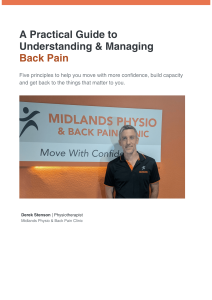
Free Back Pain Guide
A practical guide to understanding back pain, staying active, building confidence and getting back to the things that matter to you.
Download Free Back Pain Guide
Take the next step
You don't have to put up with back pain or stop doing the things you enjoy.
Whether you've recently developed back pain, have been dealing with it for months or find that it keeps coming back, a physiotherapy assessment can help you understand your symptoms and work out what to do next.
Or, if you're unsure whether physiotherapy is right for you, get in touch and we'll be happy to discuss your symptoms.