
Neck pain physiotherapy in Moate
Physiotherapy for Neck Pain
Neck pain can affect much more than just your neck. It can make sitting at a desk, driving, sleeping, exercising, working or simply getting through your day more difficult.
A clear way forward
Neck pain can make your day to day life a real struggle
Sometimes neck pain starts after an obvious injury, such as a whiplash injury, fall or awkward movement. At other times, it develops gradually without one particular incident.
You may also have been told that you have arthritis, a disc problem or "wear and tear" in your neck, and be unsure what that actually means for you.
Even when neck pain has been present for a while or keeps returning, there are often things we can work on to improve movement, build capacity and help you become more confident using your neck again.
At Midlands Physio, our aim isn't simply to relieve your pain. We want to understand what is contributing to your symptoms, help you get back to the things you love to do and give you the knowledge and tools to empower you to manage your neck with confidence.
Neck pain physiotherapy in Moate
What causes neck pain?
There are many different reasons why your neck might become painful.
Sometimes there is an obvious cause, such as a sports injury, fall, road traffic accident or sudden movement.
At other times, neck pain can develop gradually. This can happen after spending long periods at a desk, working from home, increasing your training, sleeping poorly or simply placing more demand on your neck and upper body than you are used to.
Neck pain can also be influenced by changes within the joints and discs of the neck, as well as the muscles and other tissues around the neck and upper back.
Importantly, pain doesn't always mean that you have seriously damaged your neck.
Your neck is a strong and adaptable part of your body, and pain can be influenced by a combination of physical factors, the demands being placed on you and how your body is responding to those demands.
In many cases, it isn't possible — or necessary — to identify one specific structure responsible for your pain.
Your symptoms, movement, strength, activity levels and goals are often more useful in deciding how best to manage the problem.
Neck pain physiotherapy in Moate
Common neck problems we treat
At Midlands Physio, we see people with a wide range of neck problems, including:
- Neck pain following an injury
- Neck pain following a whiplash injury
- Stiff or painful neck
- Neck pain associated with desk work
- Cervical arthritis
- Disc-related neck pain
- Nerve-related neck pain
- Pain spreading into the shoulder, arm or hand
- Headaches associated with neck pain
- Persistent or recurring neck pain
- Neck pain affecting work, exercise or everyday activities
Every person's presentation is different, so your treatment plan will be based on your individual symptoms and goals rather than simply the name given to your condition.
Your route forward
How can physiotherapy help neck pain?
It starts with a thorough assessment
We'll take time to understand your symptoms, how they're affecting you and what you want to get back to. We'll then assess your movement, strength and function to help determine what may be contributing to the problem.
From there, we'll develop a treatment plan around your individual needs and goals.
Exercise and strengthening
Exercise is an important part of managing many types of neck pain.
This might involve improving the strength and endurance of your neck, shoulder and upper back muscles, as well as improving your overall capacity to tolerate the activities you want to do.
We'll give you a personalised exercise programme through our online exercise library, with clear videos and instructions so you can confidently complete your exercises at home.
The exercises will be chosen around you and your goals rather than simply giving you a generic list of "neck exercises".
Hands-on treatment
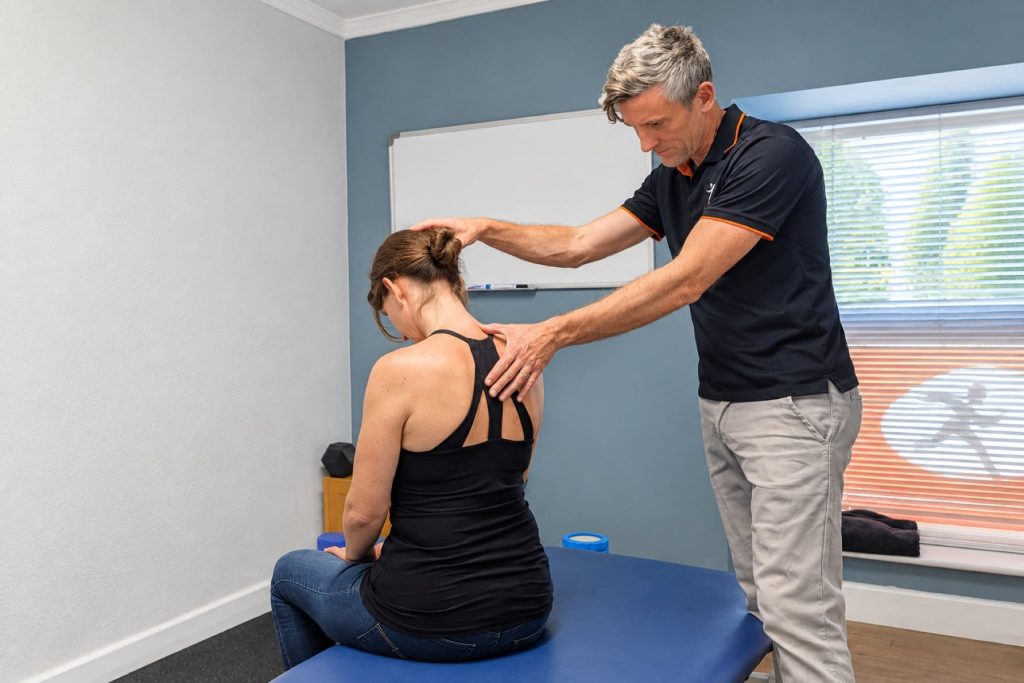
Manual therapy can sometimes be useful for helping to reduce pain and improve movement, particularly in the short term.
Where appropriate, we may use hands-on treatment alongside exercise and other strategies rather than relying on passive treatment alone.
Advice and education
Understanding your neck can be an important part of recovery.
We'll explain what we think is contributing to your symptoms, what you can safely do and how to manage your activities while your neck settles.
If you've been told you have arthritis, disc changes or another structural problem, we'll also help you understand what that diagnosis actually means for you.
Returning to work, exercise and sport
Our goal isn't simply to get you comfortable sitting at home.
Whether you want to get back to the gym, running, golf, GAA, work or simply being able to drive and sleep comfortably, we'll help you gradually build back towards the activities that are important to you.
Your route forward
When should I see a physiotherapist?
You don't necessarily need to wait until your neck pain becomes severe before getting help.
- Physiotherapy may be useful if:
- Your neck pain is interfering with work or everyday activities
- You're struggling to exercise or play sport
- Your symptoms are affecting your sleep
- Your pain keeps coming back
- Your neck feels stiff or restricted
- You have pain spreading into your shoulder or arm
- You've been told you have arthritis or a disc problem
- You've been involved in a whiplash or other neck injury
- You're unsure what exercises or activities are safe
- You've tried managing it yourself but aren't making progress
A physiotherapy assessment can help you understand what's happening and give you a clear plan for moving forward.
Helpful answers
Frequently asked questions
Open a question below for Derek’s guidance. If your symptoms are unusual or causing concern, contact the clinic or seek appropriate medical advice.
Is my neck damaged?
One of the most common concerns people have when they develop neck pain is that something has been damaged or that their neck is becoming "worn out".
Changes in the joints and discs of the neck are very common, particularly as we get older. These changes can also be seen on scans in people who have little or no neck pain.
This means that findings on an X-ray or MRI don't always tell us how much pain you should be experiencing or what you are capable of doing.
Having arthritis or degenerative changes in your neck doesn't necessarily mean that your neck is fragile or that you need to avoid movement.
In many cases, gradually improving your strength, movement and physical capacity can help you become more comfortable and confident using your neck.
Your scan is only one piece of the puzzle. Your symptoms, clinical assessment and how your neck functions are much more important when deciding how best to manage your problem.
Do I need an X-ray or MRI?
This is a common question, particularly when neck pain has been present for some time.
Scans can be useful in certain circumstances, particularly when there is a concern about a specific injury, nerve or other condition, or when the results are likely to change how your treatment is managed.
However, imaging isn't always necessary.
X-rays and MRIs can show changes in the discs and joints of the neck that are also present in people without pain. A scan can therefore provide useful information, but it doesn't necessarily explain all of your symptoms.
A good clinical assessment is often the starting point.
If you already have an X-ray or MRI report, we can help you understand what the findings mean in relation to your symptoms and what they mean for your activity.
Is my posture causing my neck pain?
Posture is often blamed for neck pain, particularly if you spend a lot of time sitting at a desk or looking at a computer or phone.
However, there isn't one perfect posture that you need to maintain all day to protect your neck.
Spending a long time in one position can sometimes contribute to symptoms, particularly if you are already uncomfortable, but this doesn't mean that your posture is damaging your neck.
Changing position regularly, taking breaks, moving your neck and upper body and building your physical capacity are often more useful than trying to maintain a "perfect" posture.
We'll look at how you work, exercise and spend your day and help you find practical ways of managing the demands being placed on your neck.
Not necessarily.
There isn't one perfect posture that protects your neck from pain.
How long you spend in one position, your activity levels, strength, stress, sleep and the overall demands being placed on your body can all influence your symptoms.
Rather than trying to maintain a perfect posture all day, it is usually more useful to move regularly and build your capacity to tolerate the positions and activities that are part of your everyday life.
Can neck pain cause headaches?
Yes.
Some headaches can be associated with problems in the neck, particularly when pain or stiffness in the neck is accompanied by a headache.
These headaches can sometimes be affected by neck movement, prolonged positions or muscle tension around the neck and upper back.
However, not every headache comes from the neck.
During your assessment, we'll consider your symptoms and the pattern of your headaches to determine whether your neck may be contributing to them and whether physiotherapy is appropriate.
If your symptoms suggest that your headache requires further medical assessment, we'll advise you on the most appropriate next step.
What if my neck pain spreads into my arm?
Pain from the neck can sometimes spread into the shoulder, arm or hand.
In some cases, this can happen because a nerve in the neck is irritated or compressed. You may also experience symptoms such as pins and needles, numbness or weakness.
This type of presentation needs to be assessed carefully.
The presence of arm pain doesn't automatically mean that you have serious damage or that you need surgery. Many nerve-related neck problems can improve with appropriate management and rehabilitation.
We'll assess your neck, arm, strength, sensation and other relevant areas to help determine what may be contributing to your symptoms and whether physiotherapy is appropriate.
If your symptoms indicate that further medical assessment or imaging is required, we'll advise you accordingly.
Should I rest when my neck hurts?
Sometimes you may need to temporarily modify what you are doing, particularly if your neck pain has followed an injury or has suddenly become much worse.
However, complete rest is rarely the long-term answer.
Your neck needs appropriate movement and loading to maintain and build its capacity.
You may initially need to reduce activities that are aggravating your symptoms, such as prolonged computer work, heavy lifting, certain gym exercises or contact sport.
That doesn't necessarily mean you need to stop them altogether.
We'll help you work out what you can safely do now, what may need to be modified and how you can gradually build your activity back up.
Why does my neck pain keep coming back?
Having one episode of neck pain can sometimes make future episodes more likely.
That doesn't necessarily mean that your neck is becoming weaker or more damaged.
Neck pain can flare when the demands placed on your body increase faster than your current capacity.
This might happen after a period of inactivity, increasing your exercise, spending more time at a desk, a busy period at work, poor sleep or simply doing more than you're used to.
Sometimes people also become cautious about moving their neck after an episode of pain, which can gradually reduce their movement, strength and confidence.
One of the most useful things you can do is gradually build your capacity so that your neck and upper body are better prepared for the demands of everyday life and the activities you enjoy.
This is why our approach isn't just about getting you through the current episode. Where appropriate, we'll also look at how you can reduce the impact of future flare-ups and become more confident managing your neck yourself.
Should I crack my neck?
Neck cracking is common and isn't necessarily harmful.
However, repeatedly manipulating your neck isn't something you need to do to keep it healthy.
If you feel that you need to crack your neck regularly because it feels stiff or uncomfortable, it may be more useful to look at why it is feeling that way and whether improving movement and strength could help.
Can I exercise if I have neck pain?
Often, yes.
Exercise is an important part of managing many types of neck pain. You may need to modify the type, amount or intensity of exercise you are doing initially, but having neck pain doesn't automatically mean that you need to stop exercising.
We'll help you find an appropriate starting point and gradually build your strength and activity levels.
Can physiotherapy help if I've had neck pain for years?
Yes.
Persistent neck pain can be more complicated than a recent episode, but that doesn't mean nothing can be done.
Treatment may involve gradually increasing your physical capacity, improving confidence with movement, addressing factors that may be contributing to flare-ups and developing strategies that allow you to manage your symptoms more effectively.
Can neck pain cause dizziness?
Sometimes neck problems can be associated with dizziness or a feeling of unsteadiness, but dizziness has many possible causes.
It is therefore important not to assume that dizziness is coming from your neck without an appropriate assessment.
If you experience new, severe or unexplained dizziness, particularly alongside other concerning symptoms, you should seek medical advice.
Do I need surgery for a trapped nerve in my neck?
Not necessarily.
Many cases of nerve-related neck and arm pain can improve with appropriate rehabilitation and time.
However, significant or worsening weakness, changes in sensation or other neurological symptoms need to be assessed carefully.
If your symptoms suggest that further medical assessment is required, we'll advise you on the most appropriate next step.
Take the next step
You don't have to put up with neck pain or stop doing the things you enjoy.
Whether you've recently injured your neck, have been dealing with pain for months or have been told that you have arthritis, disc changes or another neck condition, a physiotherapy assessment can help you understand your symptoms and work out what to do next.
Or, if you're unsure whether physiotherapy is right for you, get in touch and we'll be happy to discuss your symptoms.